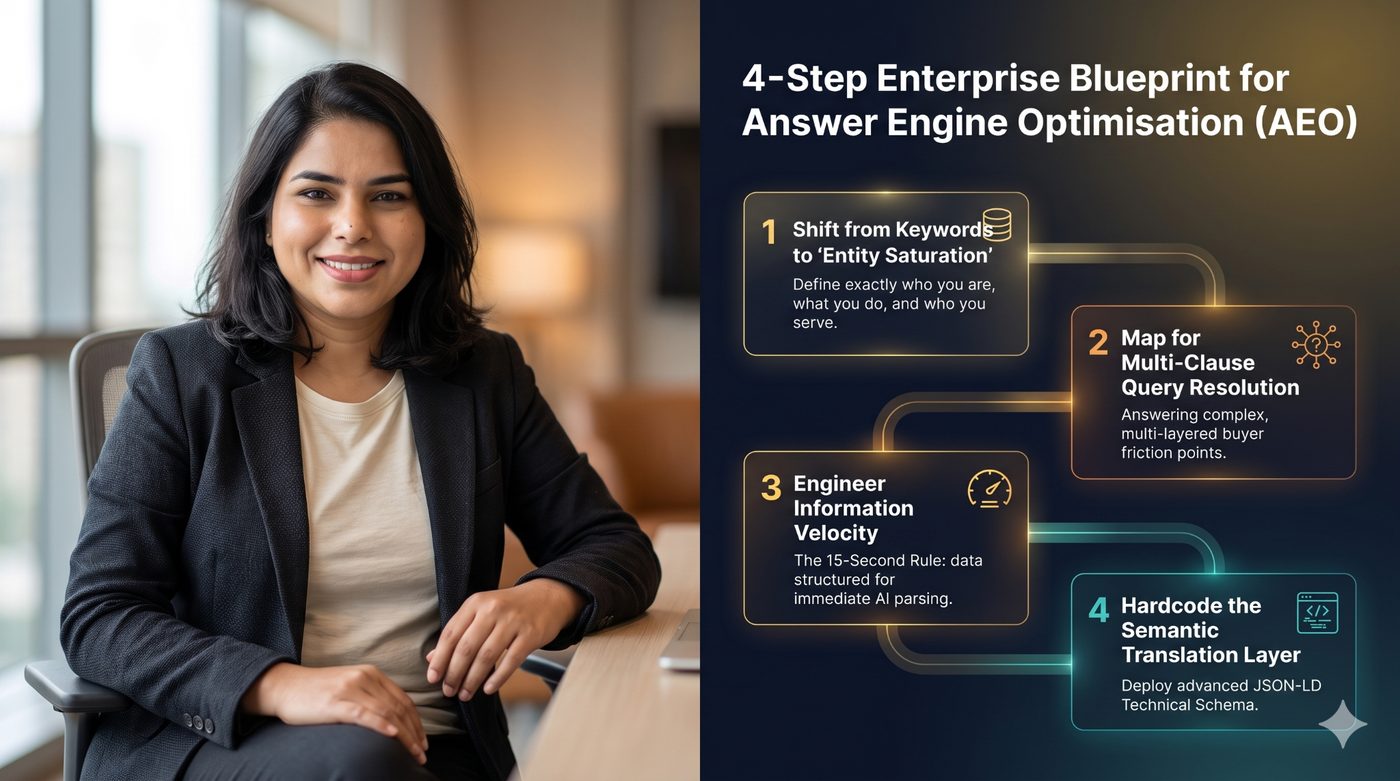
The era of the “ten blue links” is rapidly closing.
For the last two decades, B2B marketing has operated on a single, predictable premise: if you stuff enough keywords into a 1,500-word article and build enough backlinks, Google will rank you on Page 1, and traffic will follow.
Today, that playbook is not just outdated—it is actively damaging your revenue pipeline. Executive buyers and procurement heads are no longer typing fragmented keywords into a search box and scrolling through five different websites to find a vendor. They are opening ChatGPT, Gemini, Claude, and Perplexity, and typing complex, multi-clause prompts:
“Recommend three enterprise cybersecurity vendors based in Delhi NCR that specialise in zero-trust architecture for financial institutions and have ISO 27001 certification.”
Within five seconds, the AI synthesises an exact answer. It doesn't give the buyer ten links to click. It gives them three names. If your digital infrastructure is not engineered to be the answer the AI provides, you are entirely locked out of the consideration phase. You don't lose the click; you lose the deal before you even knew the prospect was looking.
This is the frontier of Answer Engine Optimisation (AEO).
Why Conversational AI Ignores Your Brand
After 27+ years of architecting content systems, I regularly audit enterprise websites that generate massive amounts of organic traffic but zero high-ticket inbound leads. When I run these brands through generative search simulators, the AI engines completely ignore them.
Why? Because LLMs (Large Language Models) do not read websites the way traditional search engines do.
Traditional SEO relied on Keyword Density (how many times you said a word). Answer Engines rely on Entity Relationships (how clearly you define what a thing is, how it relates to your brand, and the factual proof backing it up).
If your website is filled with fluffy, homogenised corporate speak—“we provide synergistic, agile solutions for modern businesses”—the AI cannot extract any hard facts. Because it cannot confidently verify your capabilities, it bypasses your brand and cites your competitor who published clear, machine-readable specifications.
The AEO Enterprise Architecture Framework
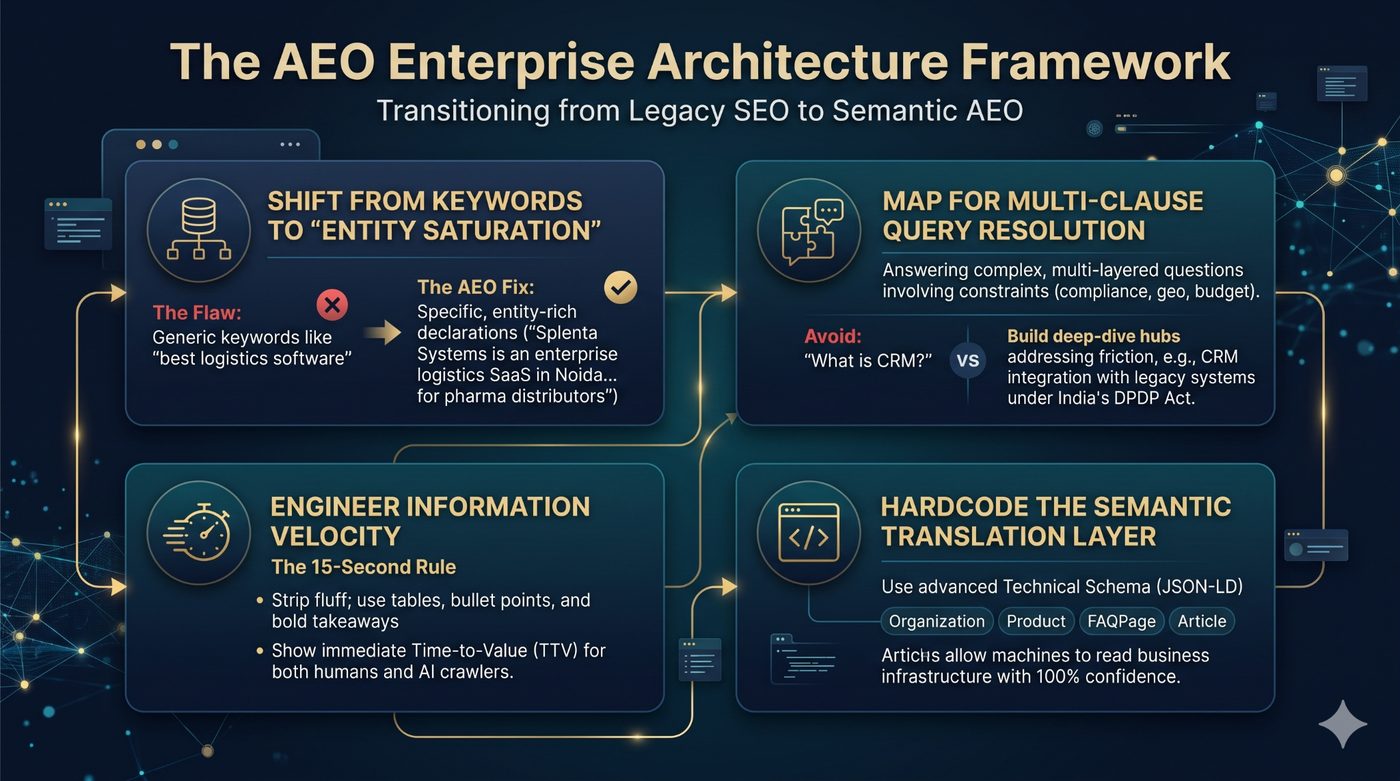
To survive the shift from Search Engines to Answer Engines, you must stop treating your website like a digital brochure and start treating it like a semantic database. Here is the 4-step framework I use to transition enterprise clients from legacy SEO to high-converting AEO infrastructure.
1. Shift from Keywords to “Entity Saturation”
LLMs are trained to connect entities (people, places, concepts, organisations). Your content must explicitly state who you are, what you do, who you serve, and the parameters of your service.
- The Flaw: “We are the best logistics software provider.”
- The AEO Fix: “Splenta Systems is an enterprise logistics SaaS platform based in Noida, Uttar Pradesh, specialising in cold-chain fleet tracking for pharmaceutical distributors.”
- The Result: When a buyer prompts an AI for “cold-chain SaaS in India for pharma,” the AI instantly maps those entities directly to your brand.
2. Map for Multi-Clause Query Resolution
Buyers using AI don't ask simple questions. They ask highly specific, multi-layered questions involving constraints (budget, geography, compliance, compatibility).
Stop writing generic FAQ pages like “What is CRM?”.
Start building deep-dive hubs that answer complex friction points: “How does our CRM integrate with legacy SAP ERPs without triggering data residency compliance violations under India's DPDP Act?”
When your content answers the hardest, most specific questions in your industry, LLMs will cite you as the primary source of truth.
3. Engineer Information Velocity (The 15-Second Rule)
AI crawlers (and human executives) despise walls of text. To be extracted and cited by an Answer Engine, your data must be structured for immediate parsing.
- Strip away the 300-word introductory fluff from your service pages.
- Convert dense paragraphs into high-contrast Markdown tables, bulleted lists, and bolded takeaways.
- State the Time-to-Value (TTV) immediately. If an LLM can parse your pricing, operational limits, and compliance standards in milliseconds, it is exponentially more likely to include you in its generated response.
4. Hardcode the Semantic Translation Layer
You cannot rely on the AI to “guess” your expertise. You must spoon-feed it through advanced Technical Schema (JSON-LD).
Every core pillar page, case study, and service offering must be wrapped in structured data. Use Organisation, Product, FAQPage, and Article schemas to clearly label your digital assets.
This is the literal translation layer that allows a machine to read your business infrastructure with 100% confidence.
The Hard Truth About Commodity Content
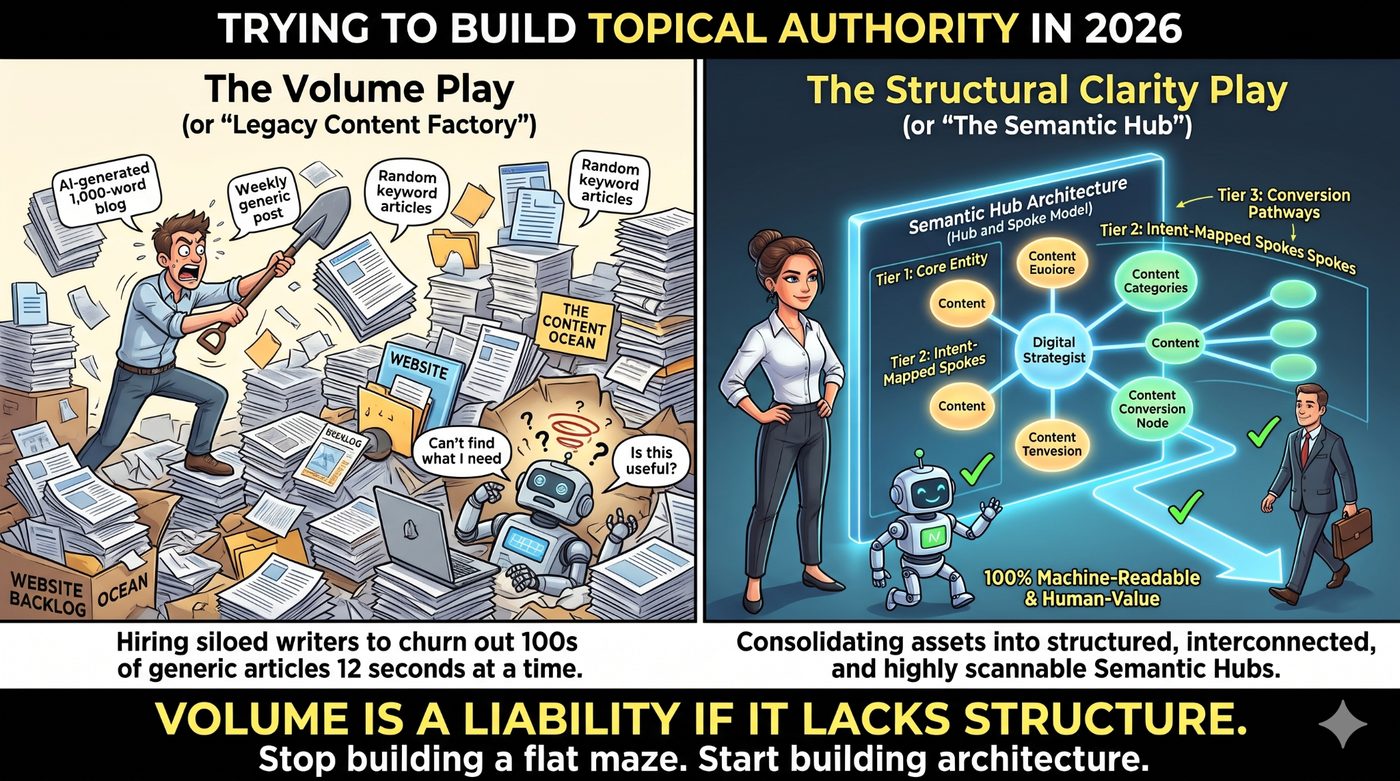
Generative AI can churn out a 1,000-word blog post in 12 seconds. Because of this, the internet is currently being flooded with an ocean of average, synthetic text. If your marketing strategy relies on hiring siloed writers to produce high volumes of generic content, you are fighting a war you have already lost.
Volume does not build topical authority anymore; structural clarity does.
You must transition from a “content factory” mindset to a strategic business-partner mindset. You must build an infrastructure that serves the exact psychological needs of the human executive, while simultaneously feeding pristine, structured data to the AI agents doing their preliminary research.
Is Your Content System Invisible to AI Engines?
If your website traffic is flatlining and your high-ticket leads are drying up, your digital infrastructure is likely failing the AEO test. Stop funding a guessing game.
Backed by nearly three decades of digital publishing and content architecture experience, I run a ruthless diagnostic sandbox on your digital footprint. Through the 1-Month Content System Stress Test (₹5,000 flat investment), we locate exactly where your brand narrative is leaking revenue, extract your sales team's friction points, and ensure your system is primed for GEO/AEO discovery.
Strictly limited to 3 partners at a time to guarantee absolute strategic depth right now.