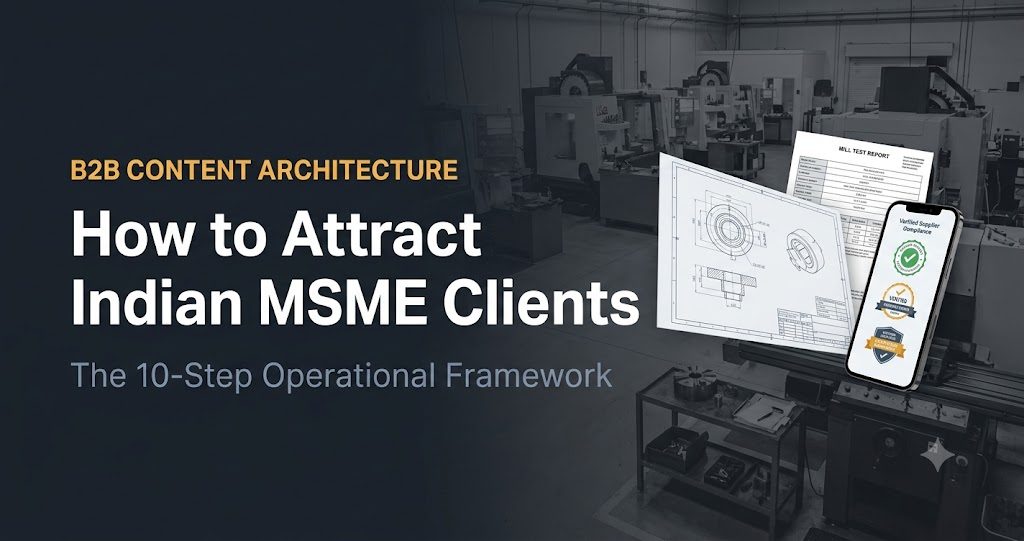
Indian MSME supplier discovery is built on personal trust, tied to local industrial hubs, and strictly practical. Unlike large enterprises relying on formal ERP procurement, Indian small and medium enterprises (SMEs) discover, vet, and contract vendors through a hybrid matrix of localised WhatsApp trade groups, regional manufacturing clusters, vertical marketplaces, and YouTube machine walkthroughs.
To convert an Indian MSME buyer, B2B digital content must function as hard operational infrastructure — providing technical specifications, statutory compliance, and flexible commercial terms within 15 seconds.
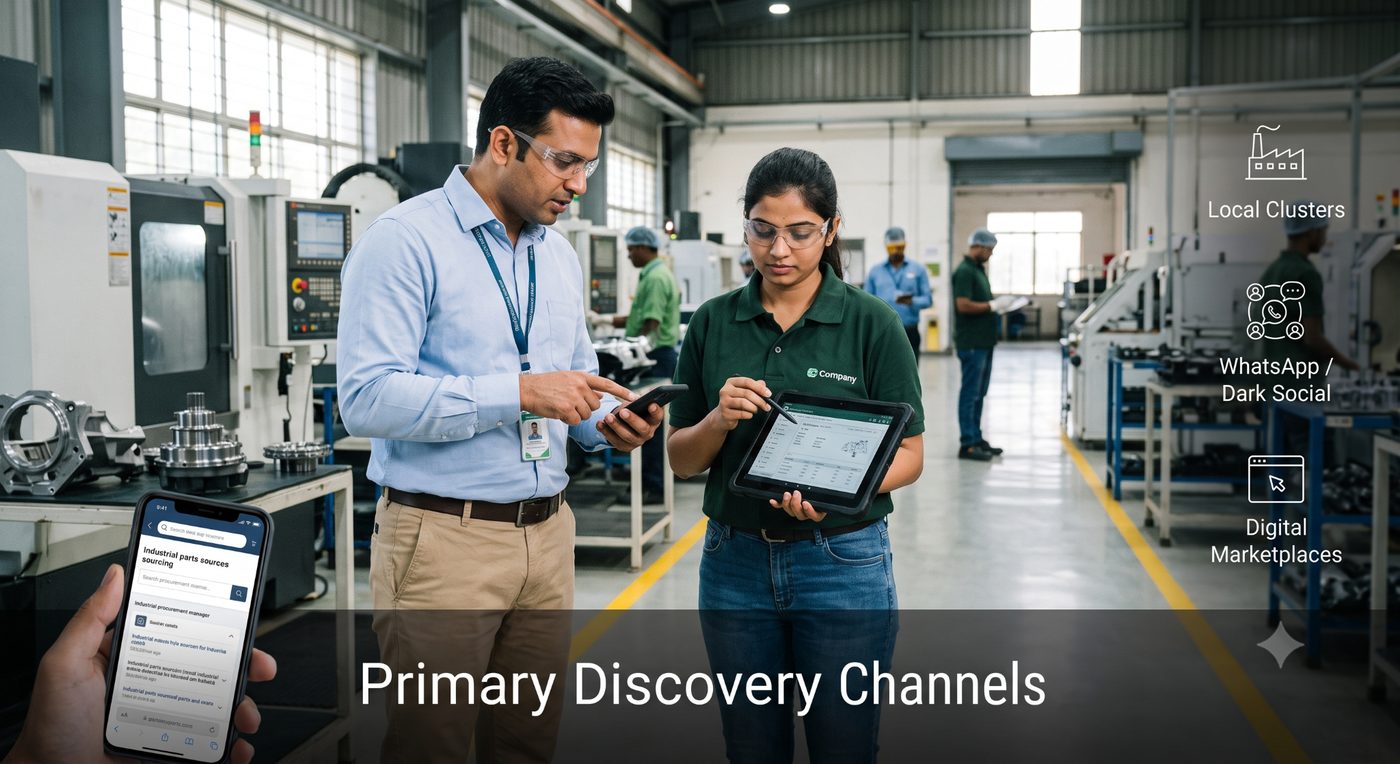
Where Indian SMEs Look for Suppliers: Primary Discovery Channels
You must understand where your clients operate if you want to deliver the right commercial message through the right channel. B2B discovery among Indian MSMEs is concentrated across six core ecosystems:
1. Horizontal B2B Marketplaces & Aggregators
- IndiaMART & TradeIndia: The default entry point for domestic discovery across raw materials, industrial hardware, and packaging. Buyers submit RFQs (Request for Quotations) to trigger competitive bidding. However, high spam rates and unqualified seller directories have created significant buyer fatigue.
- Vertical B2B Procurement Platforms: SMEs increasingly bypass open classifieds in favour of managed procurement platforms — Moglix & Industrybuying for Maintenance, Repair, and Operations (MRO) supplies and industrial power tools; Zetwerk for custom precision manufacturing, fabrication, and die-casting; and Udaan for FMCG, staples, and apparel trade retail.
2. WhatsApp & "Dark B2B" Networks
The majority of high-trust sourcing conversations happen inside unindexed mobile chat networks. Industrial estate groups (e.g., Okhla, Peenya, Manesar, Bhosari), regional trade associations, and executive peer circles function as rapid vetting clearinghouses.
Typical buyer query: "Looking for 50-micron BOPP film supplier in NCR with 30-day credit terms. References please."
A peer recommendation inside these closed circles bypasses weeks of conventional sales vetting.
3. Industrial Hub Sourcing
Indian industrial sourcing remains geographically concentrated. High-intent procurement managers target specialised regional manufacturing centres directly:
- Engineering & Machine Tools: Rajkot, Ludhiana, Coimbatore, Pune.
- Textiles & Apparel: Tirupur, Surat, Ludhiana, Panipat.
- Packaging & Plastics: Daman, Vapi, Ahmedabad.
- Foundry & Auto Components: Kolhapur, Belgaum, Jamshedpur, Chennai.
Buyers either visit these clusters during regional industrial expos or execute purchases through local brokers with boots on the ground.
4. YouTube as a Technical Search Engine
Plant managers, machinists, and promoter-engineers use YouTube as a visual validation engine. High-intent buyers look for unpolished factory walkthroughs, live machine tolerances, and destructive testing.
A video demonstrating a shop-floor CNC setup converts significantly faster than a generic brochure.
5. Government & Institutional Portals
- GeM (Government e-Marketplace): The primary portal for SMEs bidding on public sector tenders or supplying tier-1 government vendors.
- MSME Databank & EPCs (Export Promotion Councils): Critical directories for identifying verified, export-ready sub-contractors.
What Indian MSME Buyers Look For: Core Evaluation Criteria
Before evaluating brand prestige, Indian SME promoters test vendors against four non-negotiable operational hurdles:
| Sourcing Criterion | What the SME Buyer Demands | Operational Failure Point |
|---|---|---|
| Credit Terms (Udhar) | 30-to-60-day credit cycles, bill discounting, or letter of credit (LC) support. | Demanding 100% advance payment on unproven initial orders. |
| MOQ Flexibility | Willingness to deliver small pilot batches to test material compatibility. | Rigid container-load or bulk minimums on first runs. |
| GST & ITC Compliance | Active GSTIN with punctual GSTR-1 filings to ensure seamless Input Tax Credit (ITC). | Delayed invoice filing that locks the buyer's working capital. |
| Sample Turnaround | Physical prototypes or material swatches dispatched within 48–72 hours. | Protracted quotation negotiations before sample release. |
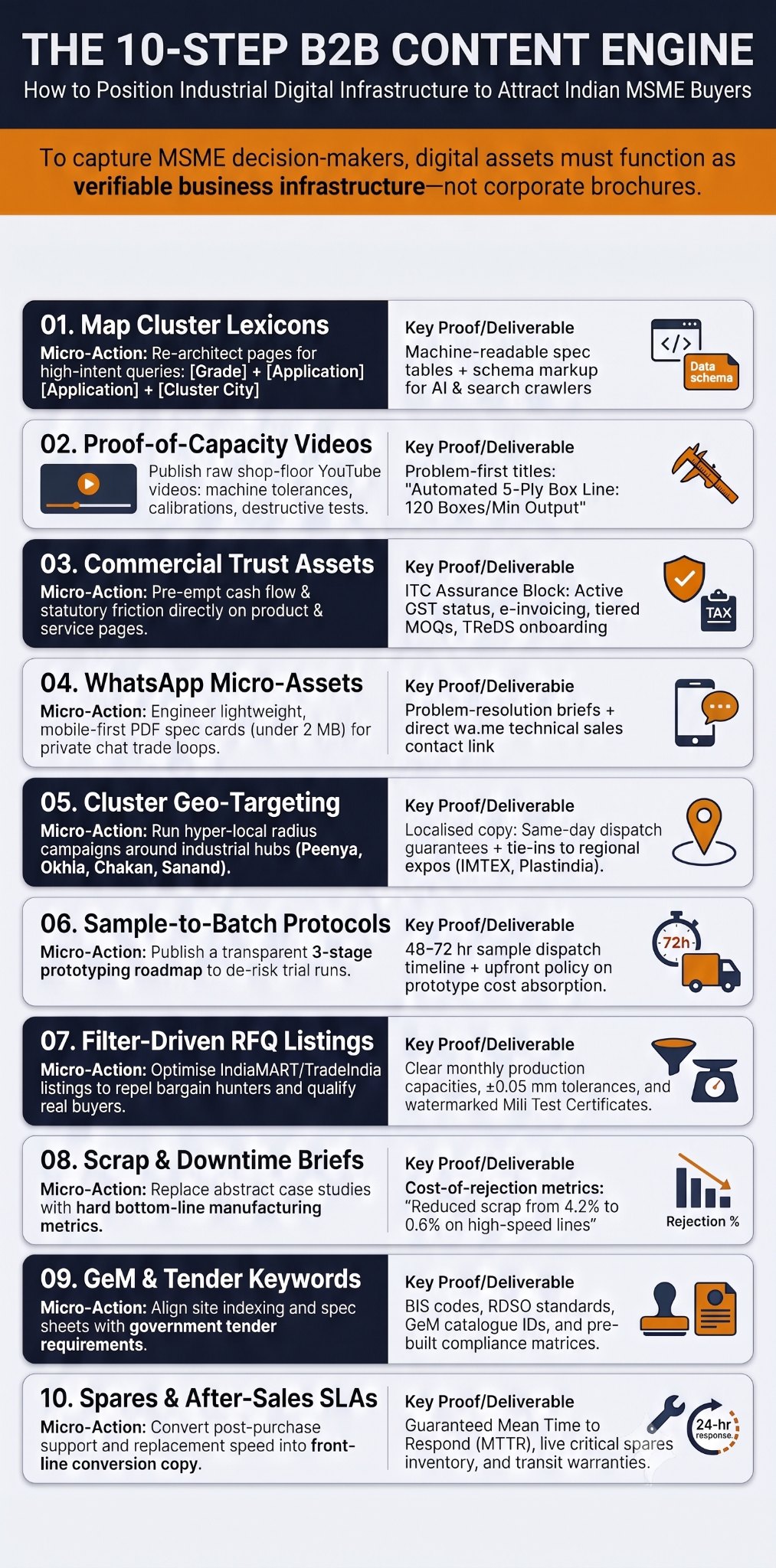
The 10-Step Content Marketing Process to Position Your Brand Inside This Sourcing Ecosystem
To capture decision-makers operating inside these specific channels and criteria, your digital assets must function as verifiable business infrastructure rather than generic corporate brochures.
1. Map Cluster-Specific Technical Lexicons
Prerequisite for search discovery and AI-assisted sourcing. Indian MSME buyers rarely search for broad category terms; they search by technical specification, grade, and vernacular trade phrasing.
- Audit exact buyer search patterns: material grades (e.g., SS 304 vs. SS 316L), dimensional tolerances, extrusion types, and industrial cluster jargon.
- Re-architect site architecture and spec sheets around high-intent query templates: [Grade / Spec] + [Industry Application] + [Hub / Cluster City] + Manufacturer.
- Structure product pages with clean schema markup and machine-readable spec tables: so Answer Engines, B2B aggregators, and search algorithms parse technical limits, output capacity, and certifications cleanly.
2. Produce 'Proof-of-Capacity' Video Assets for YouTube
Because SME promoters treat YouTube as an open-source technical directory, raw visual evidence bypasses sales scepticism faster than static PDF brochures.
- Produce unpolished, high-utility shop-floor videos: factory walkthroughs, precision CNC/lathe operations, automated packaging lines, and calibration runs.
- Document destructive and non-destructive testing directly: hydrostatic pressure tests, tensile strength tests, or spectrometer readings proving material purity.
- Title videos strictly around the industrial problem and equipment: "Automated 5-Ply Corrugated Box Making Line: 120 Boxes/Min Output Demo" rather than brand-centric corporate promos.
3. Build Trust Assets for Commercial and Statutory Friction
Indian SMEs drop prospective vendors early when friction arises around cash flow, credit, or tax credits. Address these objections directly in public-facing marketing assets.
- Publish transparent commercial terms sheets: clearly outline prototype/sample policies, tiered Minimum Order Quantities (MOQs) for trial batches, and accepted payment instruments (e.g., TReDS onboarding, bank guarantees, letter of credit support).
- Build an Input Tax Credit (ITC) Assurance Block: prominently display the vendor's active GST compliance status, e-invoicing capability, and ISO certifications directly alongside product specifications.
- Provide downloadable, one-click PDF compliance dossiers: containing MSME Udyam registration, factory licences, and standard quality audit certificates.
4. Engineer Shareable Micro-Assets for WhatsApp Ecosystems
B2B recommendations in India circulate heavily within private WhatsApp trade networks and industrial association groups. Create content formatted specifically to be forwarded across these networks.
- Design lightweight, single-page PDF spec cards (under 2 MB): that open instantly on mobile devices, complete with high-res photos, dimensional diagrams, and a direct wa.me founder/technical sales contact link.
- Format customer validation assets as rapid problem-and-resolution briefs: "How we eliminated porosity in pressure die castings for a Tier-2 auto vendor in Manesar."
- Avoid long corporate whitepapers; convert technical insights into 90-second vertical video summaries and high-contrast infographics designed for mobile chat scanning.
5. Run Geo-Targeted Account and Cluster Retargeting
Reinforce discovery within concentrated industrial zones rather than burning budget on broad, national awareness campaigns.
- Execute radius-based Meta and LinkedIn campaigns: targeted tightly around key manufacturing nodes (e.g., Peenya, Okhla Phase I–III, Chakan, Sanand, Bhosari).
- Use contextual messaging addressing localised supply chain pain points: such as fast dispatch times to local industrial corridors or same-day replacement guarantees.
- Align campaign bursts with major regional trade shows: (e.g., IMTEX, Plastindia, regional MSME vendor development meets) to capture procurement managers active in the market during expo dates.
6. Publish Transparent Sample-to-Batch Turnaround Protocols
SME buyers frequently test new vendors with small trial samples before placing commercial volume; ambiguity around sample lead times kills deals before they begin.
- Map the exact prototyping lifecycle: publish a visual 3-stage timeline showing receipt of technical drawings (CAD/STEP files), tooling/setup windows, and final dispatch within 48–72 hours.
- Specify sample dispatch logistics: list standard courier tie-ups, air-cargo options, and local factory-pickup provisions for immediate regional sampling.
- Outline clear sample-cost absorption terms: state upfront whether prototype development costs are fully credited back against the first commercial production order.
7. Optimise Directory Listings for High-Intent RFQ Conversion
B2B marketplaces like IndiaMART and TradeIndia generate high volumes of noisy enquiries; your catalogue copy must actively repel bargain hunters and qualify serious buyers.
- Replace generic product descriptions with technical thresholds: clearly state maximum monthly capacity, standard tolerances (±0.05 mm), and baseline raw material purity certificates upfront.
- Pre-empt price haggling with transparent volume slabs: display tiered pricing tied to clear MOQ thresholds to deter retail queries on wholesale listings.
- Embed instant proof of certification in catalogue media: upload watermarked photos of raw material test reports (MTRs) and mill test certificates directly into product gallery slots.
8. Systematise Customer Case Briefs Around Scrap and Downtime Metrics
Promoters and plant heads do not care about abstract branding; they buy solutions that protect their operating margins, lower rejection rates, and keep lines running.
- Structure case briefs on the 'Cost-of-Rejection' framework: detail precisely how a component or raw material batch reduced scrap rates (e.g., "Reduced rejection from 4.2% to 0.6% on high-speed bottling lines").
- Document cycle-time improvements: highlight operational wins, such as supplying pre-machined blanks that shave 12 minutes off the client's internal turning operations.
- Feature the factory head or quality control manager's voice: use direct quotes from shop-floor leads validating dimensional repeatability and batch-to-batch consistency.
9. Build Search Visibility Around Government and GeM Tender Keywords
SMEs supplying tier-1 government vendors or bidding on public procurement tenders constantly seek pre-qualified, certified sub-vendors to fulfil tender specs.
- Target public procurement tender terminology: publish content and spec sheets aligned with Bureau of Indian Standards (BIS) codes, Defence Public Sector Undertaking (DPSU) standards, and RDSO (Research Designs and Standards Organisation) specifications.
- Create dedicated GeM-ready product guides: state clearly whether your firm is registered on the Government e-Marketplace, your vendor assessment status, and available GeM catalogue IDs.
- Publish compliance matrices for tender sub-contractors: provide ready-to-submit compliance sheets that primary bidders can drop straight into their tender bidding documentation.
10. Turn After-Sales Support and Spares Availability into Core Conversion Copy
Plant managers hesitate to switch suppliers when they fear an untraceable vendor will abandon them during sudden machine breakdowns or tooling failures.
- Publish guaranteed Mean Time to Respond (MTTR) metrics: specify guaranteed turnaround times for on-site technical support and tooling recalibration within major industrial corridors.
- Document consumable and critical spares inventory: maintain a publicly visible inventory status for common wear-and-tear components and replacement tooling.
- Detail breakdown replacement protocols: clearly articulate the escalation matrix, emergency dispatch windows, and local transit warranties to remove post-purchase anxiety entirely.
Frequently Asked Questions
How do small businesses in India find B2B manufacturers?
Small businesses in India find B2B manufacturers through local industrial clusters (e.g., Rajkot, Peenya, Tirupur), private WhatsApp trade networks, vertical platforms like Zetwerk and Moglix, and horizontal directories like IndiaMART. Technical buyers increasingly rely on YouTube machinery demos to verify shop-floor capabilities prior to issuing an RFQ.
What is the most critical commercial requirement for Indian MSME buyers?
The most critical commercial requirements are flexible credit terms (30-to-60 days or TReDS bill discounting), prompt dispatch of trial samples (within 48–72 hours), and strict GST/e-invoicing compliance to ensure immediate Input Tax Credit (ITC) claiming.
Why does standard B2B content marketing fail with Indian industrial clients?
Standard B2B marketing fails because it relies on abstract thought leadership and broad corporate language. Indian industrial buyers search by precise technical specifications, material grades, cluster geography, and verifiable proof of manufacturing capacity.
Is Your Content Really Driving Your Business — Or Is It Just Deadweight?
Stop subjecting your prospects to information fatigue or technical content traps. Content volume does not build businesses. Content systems do.
If your core service pages simply mirror your competitors' phrasing, and your infrastructure remains invisible to conversational AI engines when prospects are filtering vendors, your sales pipeline is quietly evaporating.
Plug the Leaks in Your Content Engine
Backed by 27+ years of deep-dive content engineering across high-value sectors, I evaluate your digital presence not as a marketing brochure, but as essential business infrastructure.
Through the 1-Month Content System Stress Test (₹5,000 flat investment), we locate exactly where your brand narrative is leaking revenue, align your highest-intent pages with the 15-Second Rule, extract your sales team's friction points, and ensure your system is primed for GEO/AEO discovery.
Strictly limited to 3 partners at a time to guarantee absolute strategic depth.