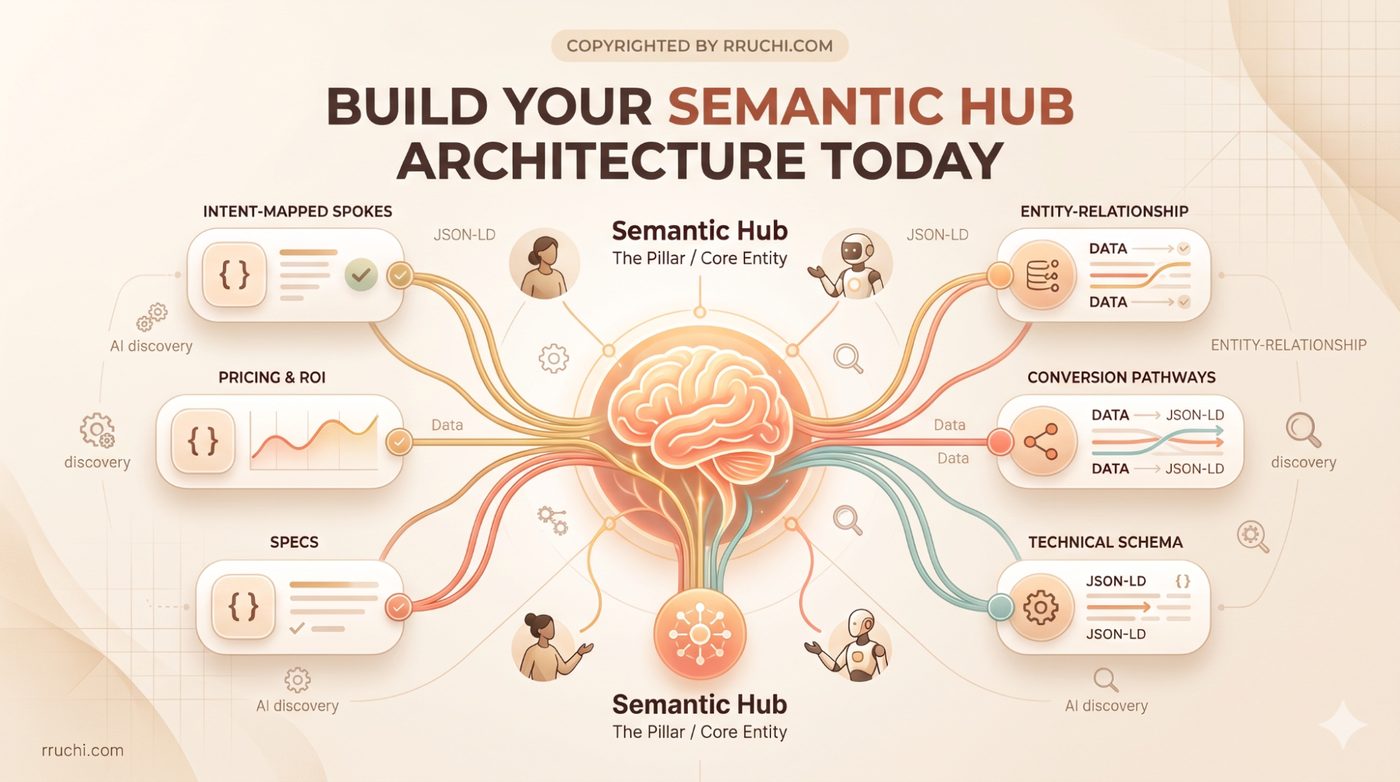
Most enterprise websites are built like digital hoarding facilities.
Every time there is a product launch, a new industry trend, or an executive whim, a new page gets published. Fast forward two years, and the website has 400 isolated blog posts, 15 overlapping service pages, and no coherent hierarchy.
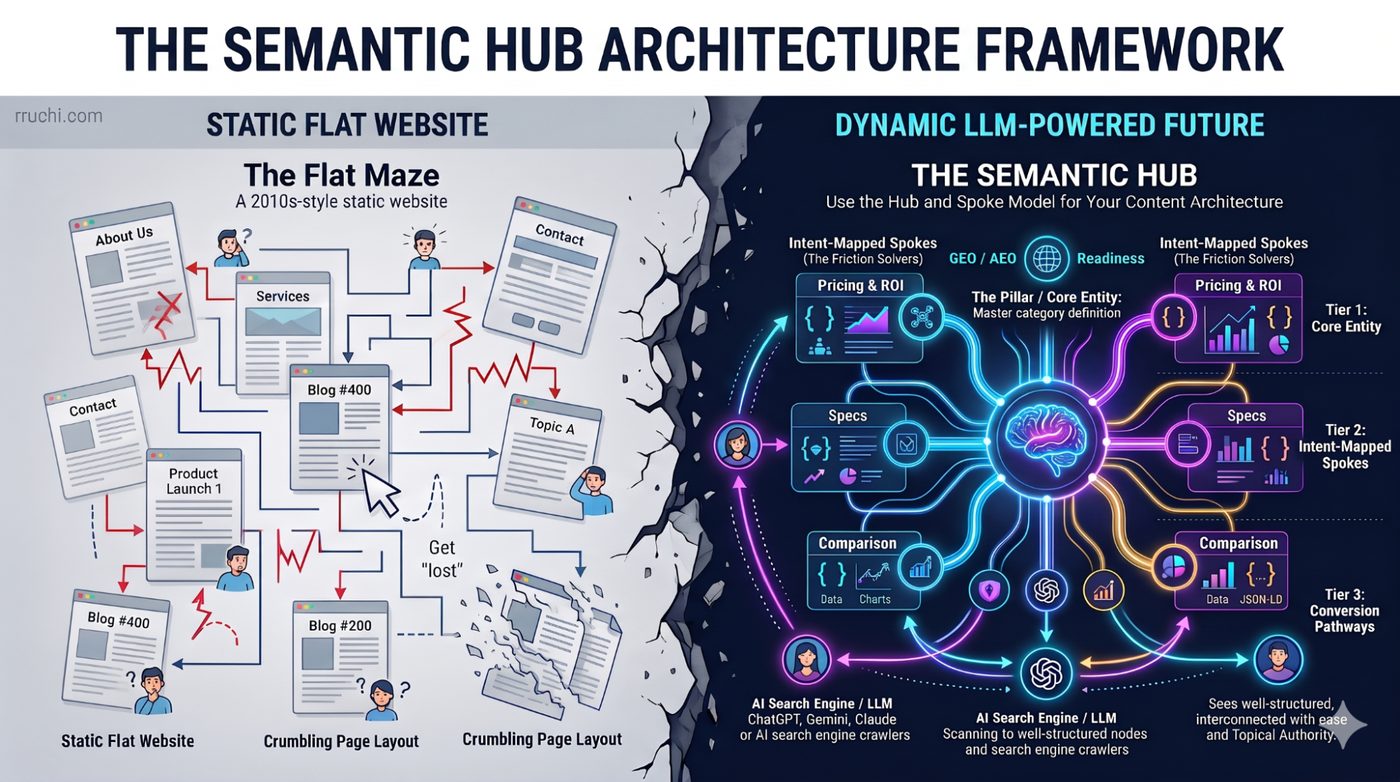
When your digital footprint is a flat, chronologically published maze, two critical failures occur:
- The Human Failure: A senior decision-maker lands on your site, gets overwhelmed by fragmented information, and bounces within 10 seconds.
- The AI Failure: Conversational AI engines (ChatGPT, Gemini, Claude) crawl your site, fail to establish your “Topical Authority” because your semantic relationships are broken, and bypass your brand entirely when a user asks for vendor recommendations.
After 27+ years of architecting content systems, I can tell you definitively: volume is a liability if it lacks structure. You do not need more freelance writers churning out 1,000-word SEO articles. You need Content Architecture.
The Semantic Hub Architecture Framework
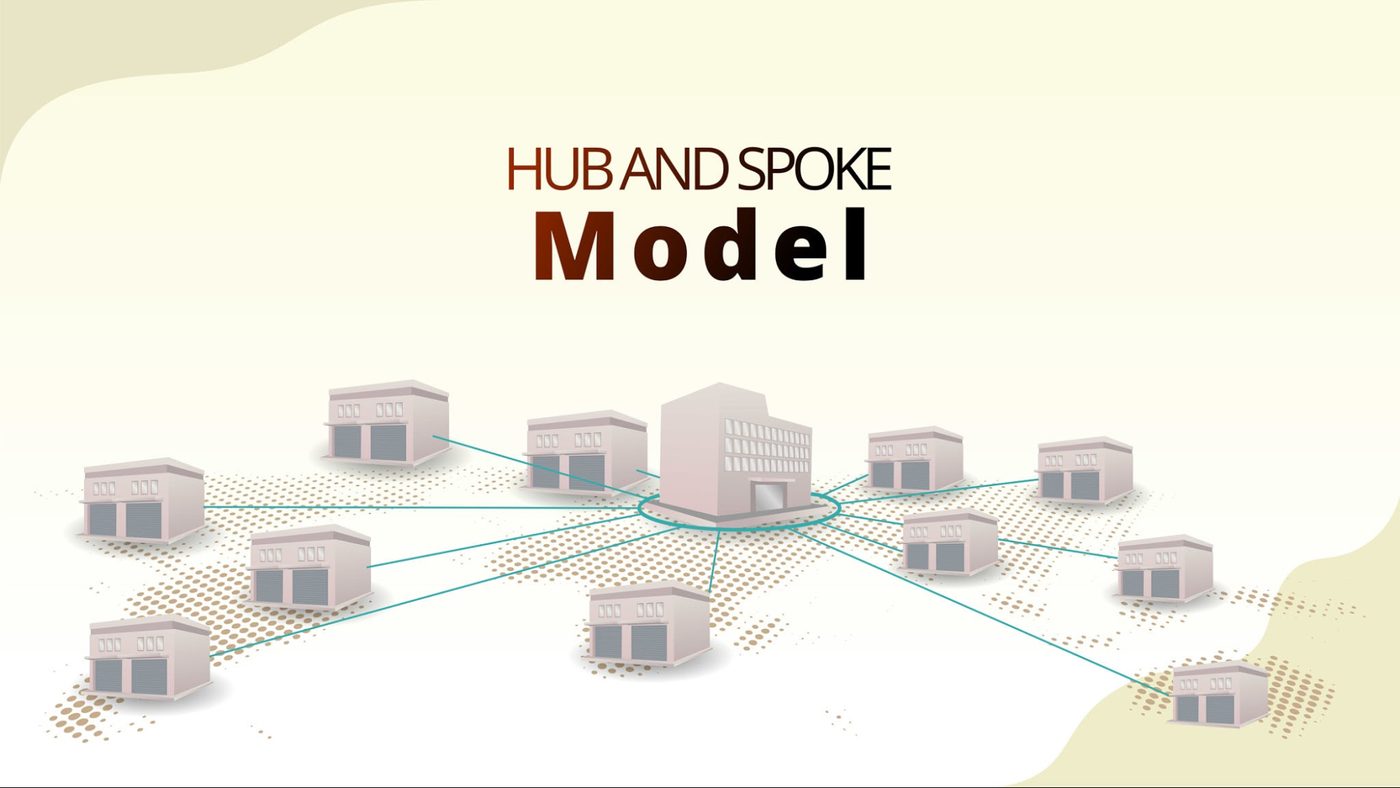
To convert high-ticket B2B buyers and dominate Answer Engine Optimisation (AEO), your content can no longer exist as standalone URLs. It must be engineered as a heavily structured Semantic Hub.
Here is the exact 3-Tier Framework I use to transform scattered corporate blogs into high-converting revenue infrastructure.
Tier 1: The Core Entity (The Pillar)
In the era of Generative Engine Optimisation (GEO), search engines and LLMs no longer read for “keywords”—they read for Entities. The Core Entity is your unassailable, 3,000+ word master pillar page. It does not sell. It exhaustively defines a single complex problem or category that your business solves (e.g., “Industrial Fluid Dynamics” or “B2B Supply Chain Compliance”).
- The AI Purpose: It acts as the gravitational centre for search algorithms and LLM training data, heavily marked up with JSON-LD schema so machines understand exactly what you do.
- The Human Purpose: It serves as the ultimate bookmarkable reference for a mid-level manager tasked with researching a complex procurement problem.
Tier 2: Intent-Mapped Spokes (The Friction Solvers)
If the Core Entity is the textbook, the Spokes are the specific chapters answering specific buyer anxieties. These are shorter, highly targeted pages (800–1,200 words) that link directly back to the Core Entity. Instead of writing random industry news, you map these spokes directly to the sales team's friction log:
- Pricing & ROI Spokes: “The Hidden Costs of Implementing [X]”
- Comparison Spokes: “Why [Solution A] Fails in High-Volume Manufacturing”
- Technical Specs: “Tolerance Limits for [Specific Material]”
- The 15-Second Rule: Every spoke must be ruthlessly formatted for executive scanning. Bold takeaways, high-contrast data tables, and an immediate Time-to-Value (TTV) in the first paragraph.
Tier 3: The Conversion Pathways (The Infrastructure Logic)
Internal linking is not an “SEO tactic.” It is the literal business logic of your website. In a flat architecture, a user reads a blog and hits a dead end. In a Semantic Hub, the internal links are engineered based on buyer psychology.
- If a user is reading a Tier 2 spoke about “Compliance Failures,” the pathway shouldn't link to your Homepage. It should link to a downloadable compliance checklist (lead capture) or a case study showing how you solved this exact failure for a competitor (conversion).
The Latest Trend: Why LLMs are Killing “Flat” Websites
Let's look at a recent operational reality.
A mid-sized industrial tooling client came to me with a massive drop in qualified inbound leads. Their marketing agency had been publishing four 500-word blogs a month for three years. The site had traffic, but zero pipeline.
When we ran a generative search audit, we realised why: when buyers prompted AI engines with “Recommend precision tooling vendors for automotive die-casting in Pune,” the AI ignored our client. Why? Because the client's information on “automotive,” “die-casting,” and “Pune” were scattered across 40 different, unconnected blog posts. The AI could not parse their capacity.
The Fix: We deleted 120 low-value posts. We consolidated the remaining assets into three massive Semantic Hubs tied directly to their core manufacturing capacities. We hardcoded the technical specs and geography into the schemas.
The Result: Top-of-funnel vanity traffic dropped by 18%. But RFQ submissions from Tier-1 automotive suppliers increased by 46% within four months.
When you organise your data, both AI and executives reward you with trust.
The Content Architecture Scorecard
Evaluate your current website architecture against this clinical matrix. Where does your enterprise sit?
| What We Are Measuring | The Capital Bleed (Score 1–2) | The Baseline (Score 3–4) | The Revenue Engine (Score 5) |
|---|---|---|---|
| Site Structure | Chronological blog roll. Pages live in isolation. Dead ends everywhere. | Basic categories exist, but internal linking is random or automated. | Strict Hub-and-Spoke architecture. Every page is mapped to a specific buyer intent. |
| AI Readiness (GEO/AEO) | Keyword-stuffed. No technical schema markup. Ignored by LLMs. | Basic SEO tags in place, but no entity-relationship mapping. | Highly structured data. AI confidently cites the brand as a primary source of truth. |
| Executive Scannability | Walls of text. Fluffy introductions. Fails the 15-Second Rule. | Uses H2s and some bullets, but hides the USP at the bottom. | Ruthless Time-to-Value. Data tables, bold takeaways, and immediate operational insight. |
Is Your Content System Leaking High-Value Leads?
If your website feels like an expensive labyrinth rather than a predictable revenue generator, stop hiring more writers. You need an architectural intervention.
Through the 1-Month Content System Stress Test (₹5,000 flat investment), we map exactly where your digital architecture is broken, align your highest-intent pages with the 15-Second Rule, and ensure your system is primed for GEO/AEO discovery.
Strictly limited to 3 partners at a time to guarantee absolute strategic depth.